
For Grantmakers
Everything a funder needs to evaluate More Precious Than Rubies, in one place. Our complete prospectus — capital and operating budgets, phased plan, and full outcomes framework — is available to grantmakers on request.
01
Organization
Legal name: More Precious Than Rubies Women’s Independence Village, Inc.
Tax status: EIN 42-4472231. Exempt from federal income tax under Section 501(c)(3) and classified as a publicly supported public charity under Section 170(b)(1)(A)(vi). IRS determination letter dated August 27, 2026; exemption effective August 6, 2026. Contributions are deductible under Section 170.
Mission: To help women and children move from domestic abuse and housing instability toward safety, healing, and lasting independence.
Location: Polk County, Florida.
Leadership: Founder & President: Courtney B. Vann. Vice President: Brent Knipp. Secretary: Kelly Bodenhamer.
Board of directors: Founding board being seated; a multidisciplinary advisory council is being formed. Members named as confirmed.
Organizational history: Established to build Florida’s first Women’s Independence Village — a secure residential community pairing housing with wraparound support. Currently pre-launch, in the capital-campaign and site-selection phase.
02
Program
Problem addressed: Survivors of domestic abuse often must choose between staying in danger or leaving with nowhere safe to go. Emergency shelters provide immediate refuge but not the transition to independence, and Florida’s certified DV centers cannot keep pace with demand.
Population served: Adult women and their children who are survivors of domestic abuse and seeking to rebuild. Participation is voluntary and open regardless of race, religion, national origin, disability, or background. Eligibility requires experience of domestic abuse — including psychological, emotional, financial and coercive control, not only abuse producing physical injury — verified either by documentation from an external source or by a written assessment from a qualified professional, supported in either case by the applicant’s own written attestation; homelessness or imminent risk of homelessness as a result of leaving an abusive household; and agreement to take part in case management. Applications are accepted both directly from applicants and by referral, under the same written screening criteria. Household income is not a condition of eligibility and is not used to screen applicants. Not fewer than 20% of the homes are reserved for households at or below 50% of area median income and not fewer than 75% for households at or below 80%, with the remaining homes carrying no income limit — seven, twenty and eight respectively at the full build-out of thirty-five. These proportions are set so that the Corporation continues to satisfy the safe harbor of Revenue Procedure 96-32. Where demand exceeds capacity, applicants are prioritized on risk of harm, the absence of available alternatives, and household income, weighted together. Prior admission to an emergency shelter is not required.
Geographic area: Polk County, Florida.
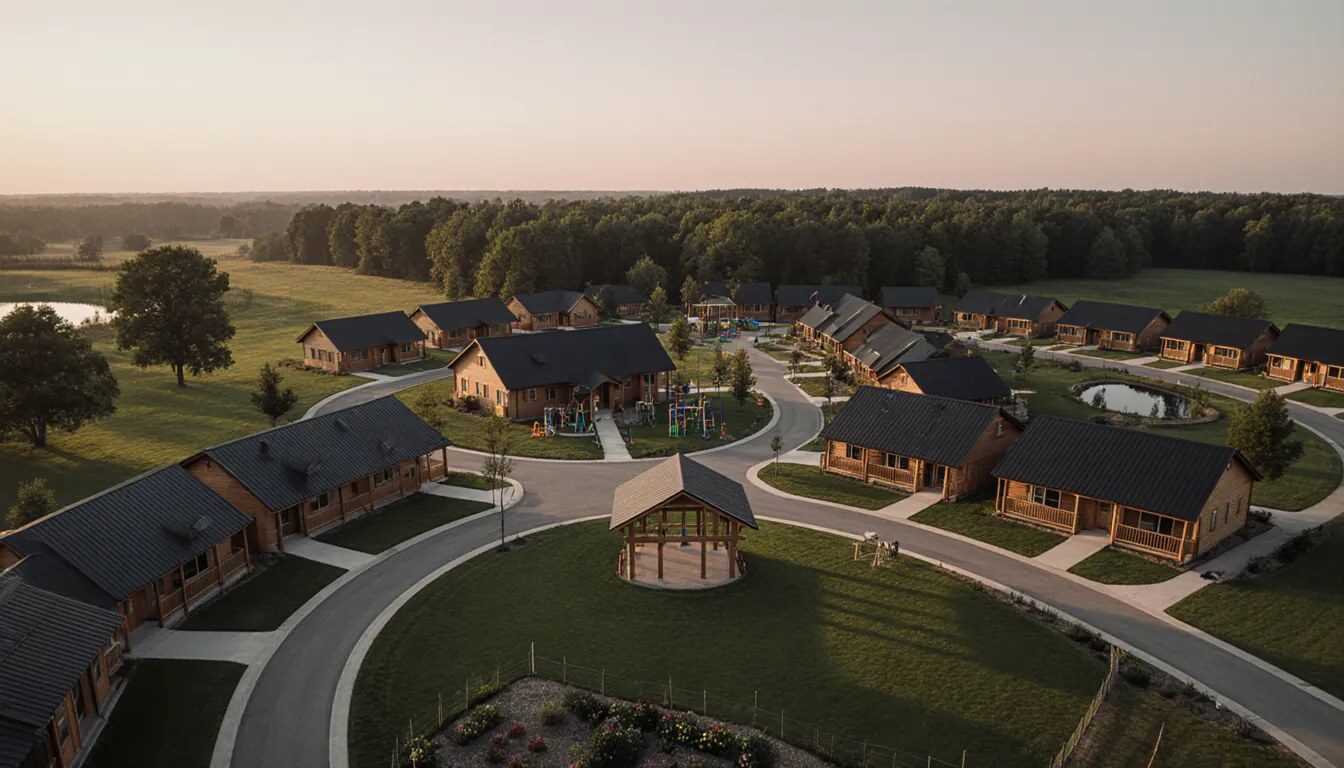
Program model: A secure campus of private tiny homes with wraparound services in one place — safe housing, trauma-informed counseling, children’s services, education, workforce development, and financial literacy — guided by an individualized plan for every resident. Transitional (not emergency) housing, with an average length of stay of 8 to 12 months. The Corporation provides transitional housing and does not provide crisis intervention or emergency shelter.
Planned capacity: the five measures below are distinct and are not interchangeable. Physical capacity — 35 homes at full build-out, opening with the first 15. Households in residence — approximately 32 at any one time, at 92% occupancy. Individuals in residence — approximately 97 at any one time. Households completing the program — approximately 32 to 48 in a stabilized year. Individuals served — approximately 95 to 145 in a stabilized year. Figures are at full build-out and remain subject to confirmation by the Treasurer.
03
Project
Development plan: Acquire a secure Florida property, develop site infrastructure, and build homes plus the counseling and education centers in phases — opening early and expanding to the full 35-home community.
Current phase: Phase One — property acquisition and site development (pre-launch).
Timeline: Measured from campaign launch. Year 1: campaign, governance, and site identification. Year 2: acquisition, design and permitting, and construction. Year 3: open and welcome the first residents. Years 4–6: expand to 35 homes at full build-out.
Total project cost: $10 million full campaign. Of that, roughly $6.8 million covers Phases 2 and 3 — site development and the opening build of 15 homes plus the two program buildings. Phase 1 Pre-Development is $175,000 and is the current ask.
04
Funding Request
Current phase and ask: Phase 1 — Pre-Development: $175,000. The project is delivered in four phases: Phase 1 Pre-Development ($175,000, current); Phase 2 Site Development (clearing, grading, roads, stormwater, water and sewer, electrical, security fencing, foundation pads, impact fees and permits); Phase 3 Construction (15 homes at opening and 35 at full build-out at roughly $70,000 each, plus the Counseling and Wellness Center, Education and Workforce Center, and Welcome Center); Phase 4 Operational Readiness (staffing, training, furnishings, program systems, insurance and operating reserve). Total campus $10,000,000.
Current funding: $100 secured to date against the Phase 1 goal (cash and signed pledges). No government funds received.
Remaining: $174,900 to complete Phase 1. Phases 2 through 4 will be costed from the Phase 1 civil engineering and architectural work and published as each phase is scoped.
Phase 1 line items available for funding: Land appraisal ($4,500) · boundary and topographic survey ($6,500) · Phase I environmental site assessment ($3,500) · geotechnical investigation ($7,500) · conceptual master site plan ($18,000) · preliminary civil engineering ($22,000) · architectural concepts ($15,000) · land use and zoning analysis ($6,000) · option deposit to secure site control ($25,000). Naming opportunities in later phases: Village Naming Partner ($2.5M) · Education & Workforce Center ($1M) · Counseling & Wellness Center ($750K) · Children’s Learning Center ($500K) · Community Pavilion ($250K) · Cabin Cluster ($100K). Naming is subject to a board-approved recognition policy and a written gift agreement. Program and operating support are also welcomed.
05
Measurement
Outcomes (targets at full operation): 85%+ exit to permanent, stable housing · 85%+ employed or advancing in education/training at exit · 75%+ complete the program (graduate) · 80%+ build emergency savings · 90%+ report improved safety and reduced fear · 100% have an individualized independence plan. Board-set start-up projections, adopted by resolution of the Board of Directors. They are not externally validated, and actual results will be published annually once the Village is in operation.
Evaluation methodology: Intake assessment at arrival; ongoing case-management records; validated screeners (MOVERS, PHQ-9, GAD-7, WHO-5); program-completion and employment data; resident satisfaction surveys; and 6- and 12-month post-exit follow-up. A full logic model (Inputs → Activities → Outputs → Outcomes → Impact) guides the framework.
Reporting: Targets are set annually by the board, reported regularly to funders and partners, and published each year once the Village opens.
06
Financial Information
Project (capital) budget: $175,000 Phase 1 Pre-Development is the current ask. The later phases total roughly $6.8M — property ($2.5M), first 15 furnished homes ($1.05M), the Education & Workforce and Counseling & Wellness Centers, infrastructure, security, contingency, and an initial operating reserve; $10M full campaign. Full itemization in the prospectus.
Operating budget: Pre-launch; the stabilized operating model runs about $57,000 per family per year at full capacity. Start-up operating budget available on request.
Financial statements: Available to funders on request; the organization will publish financials and annual reports as it grows.
IRS determination letter: EIN 42-4472231. IRS Letter 947 dated August 27, 2026, granting exemption under Section 501(c)(3) with public charity status under Section 170(b)(1)(A)(vi), effective August 6, 2026. A copy is provided with any application on request. Florida charitable registration CH84832, valid through August 20, 2027. A Candid/GuideStar transparency profile is being established.
07
Contact
Grant inquiries: info@morepreciousthanrubiesvillage.org
Available on request: The complete prospectus, capital and operating budgets, phased development plan, and outcomes framework.

