
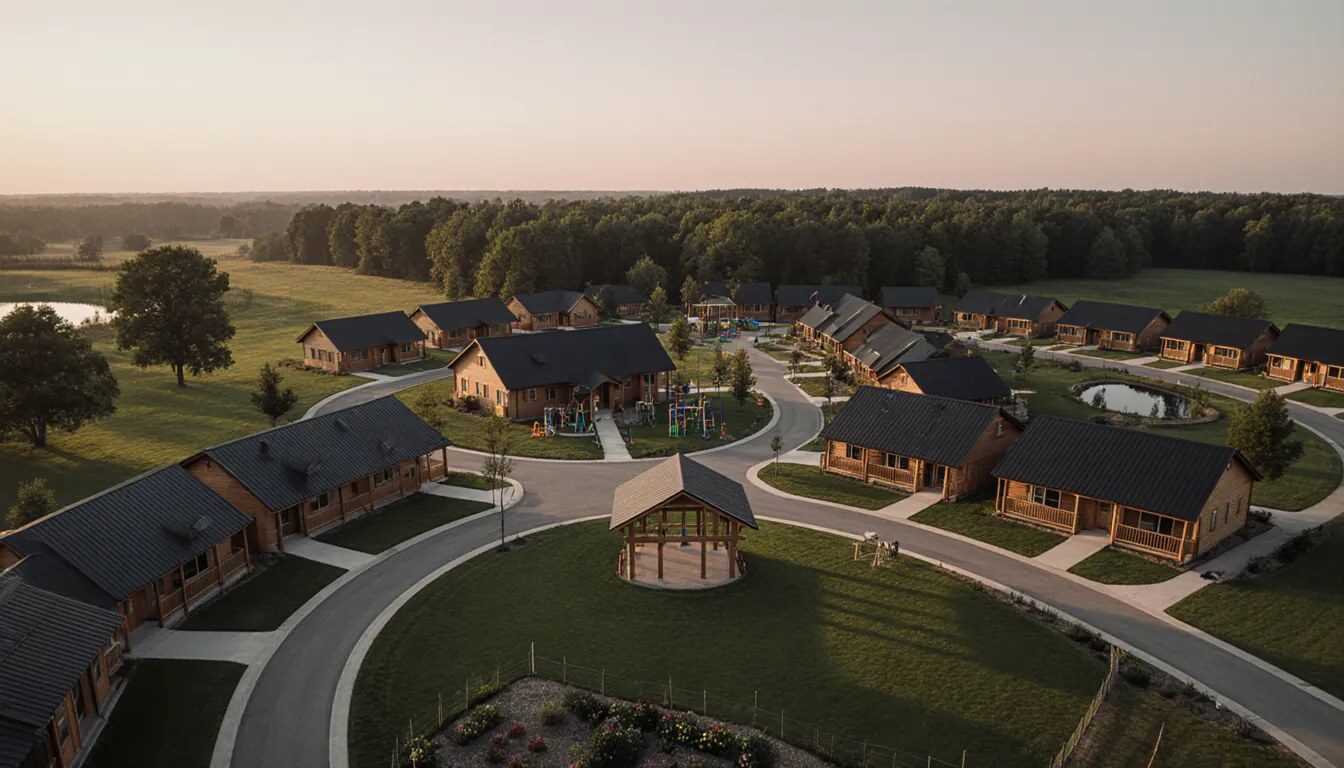
Hope Lives Here.
We build the homes. She rebuilds her life. God restores her hope.
More Precious Than Rubies is building the Women’s Independence Village — a safe place in Florida where women and children escaping domestic abuse can heal, rebuild, and step into lasting independence.
The Problem
Leaving abuse isn’t the end of the journey.
For a woman who finds the courage to leave, safety is only the first step. Without a safe place to land and the support to rebuild, too many families are forced back into danger. The gap between escaping harm and building an independent life is where they fall — and it is staggering.
58%
of survivors’ unmet requests for help in a day were for housing
83%
of survivors entering shelter name housing as a top need
80%+
of mothers facing homelessness have survived domestic abuse
624,269
nights of emergency shelter provided by Florida’s DV centers in a year
Sources: NNEDV 20th Annual DV Counts (2025); Florida DCF Domestic Abuse Annual Report.
Our Solution
The Women’s Independence Village
A secure Florida campus of private tiny homes, where a survivor and her children have a place of their own — and where everything they need to rebuild comes together in one place.
Safety. Healing. Independence.
How It Works
Every resident follows a clear path — at her own pace, with a whole community behind her.
1. Safe Housing — a private tiny home of her own, and immediate safety.
2. Stabilization — basic needs met; counseling and an individualized plan begin.
3. Healing — trauma-informed care for her and her children.
4. Education & Workforce Development — skills, training, financial literacy, and real employment.
5. Permanent Independence — a savings cushion, restored credit, and a permanent home of her own.
The Impact
The Village at full build-out
35
homes at full build-out — 15 at opening
32
households in residence at any one time
97
individuals in residence at any one time
32–48
households completing the program each year
Projected figures at full build-out, and about 95 to 145 individuals served in a stabilized year. These five measures are distinct and are not interchangeable. We will publish actual results every year once we open.
A Story Like Hers
The story we’re building to make true
She arrives after dark, two children asleep against her shoulders and everything she could carry in a single bag. For the first time in longer than she can remember, no one is shouting. Someone shows her to a small home that is entirely her own — a door that locks, a bed for each of her kids, a kitchen table. That night, she sleeps.
Over the months that follow, she rebuilds what was taken: counseling to heal, classes to finish, a savings account that grows, work that is hers. She is not being rescued — she is doing the rebuilding, with a whole community behind her. And one day she leaves — not back into danger, but forward, into a home of her own.
Illustrative — a composite drawn from the real journeys of survivors, and the future your support is building to make true.
The Hope Lives Here Campaign
Building the Village in Four Phases
We are building the Village in four phases. Phase 1 is pre-development — the due diligence, design and entitlement work that secures a site and proves the campus can be built. The completed Village is a $10 million vision.
Every gift goes straight to work on Phase 1. We are a 501(c)(3) public charity, EIN 42-4472231, so your gift is tax-deductible to the extent allowed by law. If you would like to talk with us before you give, reach out at info@morepreciousthanrubiesvillage.org.
The Plan
We Build It in Four Phases
A village does not get built all at once, and it should not be funded all at once either. Here is the order of the work, what each phase pays for, and exactly where we are today.
Current phase · $175,000 goal
Phase 1 — Pre-Development
Secure a site and prove the Village can be built.
- Land appraisal, boundary and topographic survey
- Phase I environmental site assessment
- Geotechnical investigation and soil borings
- Title work, closing costs, and the option deposit that secures site control
- Conceptual master site plan for the 35-home campus
- Preliminary civil engineering — grading, stormwater, utility routing
- Architectural concepts for the homes and the two program buildings
- Utility availability and capacity study
- Land use and zoning analysis, impact fee analysis, county pre-application meetings
- Real estate and nonprofit legal counsel, accounting, and insurance
Next
Phase 2 — Site Development
Turn raw land into a secured, buildable campus.
- Clearing, grading, and the internal road grid
- Stormwater management system
- Water and sewer infrastructure
- Electrical service, transformers, and site lighting
- Perimeter security fencing, gated entry, and cameras
- Engineered foundation pads for each home
- County impact fees and building permits
Then
Phase 3 — Construction
Build the homes and the buildings where the work happens.
- 15 private homes at opening and 35 at full build-out, roughly $70,000 each
- Counseling and Wellness Center
- Education and Workforce Center
- Welcome Center and administration building
- Children’s play areas, walking paths, and community space
- Appliances, fixtures, and furnishings
Finally
Phase 4 — Operational Readiness
Staff the Village and open the doors.
- Executive leadership, case managers, and licensed counselors
- Children’s program staff, facilities, and security personnel
- Trauma-informed care training for every team member
- Furnishings and welcome kits for arriving families
- Program curriculum, technology, and case management systems
- Insurance, utilities, and an operating reserve
Every gift is applied to Phase 1. Each phase begins only when the one before it is funded. We will not break ground before the land is secured, and we will not build homes before the infrastructure is in. As set out in our Use of Gifts policy, contributions are not legally restricted to a single phase, which lets our Board respond if circumstances change — our commitment is to fund the phases in order and to report our progress publicly.
Why Give
A model that works
Housing plus every support in one place, so stability compounds instead of scattering.
Outcomes, not activity
Clear, measurable targets we hold ourselves to — and report every year.
A ground-floor opportunity
Help build something lasting — with the chance to name a home or a building.
Every gift is tangible
Tied to a real outcome, from a family’s first month to an entire home.
Trust & Transparency
We hold ourselves to the standards funders expect — and share more than most new nonprofits ever do.
Tax status: 501(c)(3) public charity, EIN 42-4472231. The IRS issued our determination letter on August 27, 2026; exemption is effective August 6, 2026 and gifts are tax-deductible as allowed by law.
Governance: Founding Board of Directors and a multidisciplinary Advisory Council being seated.
Leadership: Courtney B. Vann, Founder & President · Brent Knipp, Vice President · Kelly Bodenhamer, Secretary.
Accountability: Published financial commitments and a full outcome-measurement plan (validated tools, 6- & 12-month follow-up).
Reporting: Annual impact reports once we open; EIN and a Candid/GuideStar transparency seal added when available.
Partners
Our founding partners are being welcomed now. We’re building relationships with employers, colleges, faith communities, service providers, and foundations who share our mission — and there’s room for your name among the first.
We believe every woman is created with dignity, purpose, and worth.
Every woman is more precious than rubies.
Help us build a place where she can discover it.
 More Precious Than Rubies